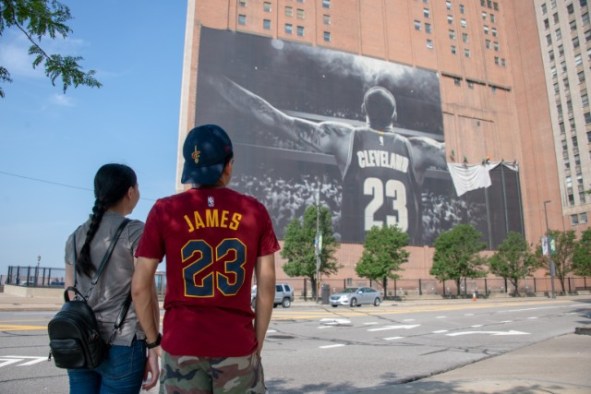
Lebron James To Los Angeles

GettyImages-990764650-1530638807-640x427.jpg

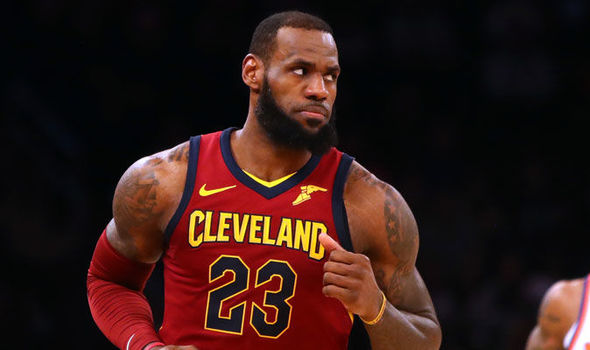
IT is done. We’ve known since the announcement was made on July 1, but now it’s official. LeBron James is a Los Angeles Laker.

As expected, and just like the announcement of the agreement, we first learned the news from the social media channels of Klutch Sports Group; James sitting alongside his agent, Rich Paul, and the general manager of the Lakers, Rob Pelinka. On the table in front of the three men: a newly-inked contract.

The four-year, $153 million deal – a player option in the fourth year – will see James join one of the most storied franchises in sport, with Pelinka and Lakers president of basketball operations, Magic Johnson, sealing the signing of the four-time NBA MVP.

“Today is a great day for the Lakers organization and Lakers fans all over the world to welcome LeBron James, a three-time NBA Champion and four-time NBA MVP,” Johnson said in a statement.

“LeBron is special. He is the best player in the world. He loves to compete and is an awesome leader who is about winning and making sure that his teammates are successful.

“The Lakers players are excited to have a teammate who has been to nine NBA Finals. It’s a huge step closer to returning the Lakers to the playoffs and to the NBA Finals.”

Barring any trades, the Lakers will have a young team around James, led by the likes of Brandon Ingram, Lonzo Ball, and Kyle Kuzma. Kentavious Caldwell-Pope re-signed with the team on a one-year deal, along with Lance Stephenson, JaVale McGee, and Rajon Rondo.

Luke Walton, the head coach of the Lakers, led the team to a 35-47 record, over the 2017-18 season, with the legendary franchise missing the NBA playoffs for the fifth straight year.

For a team that’s regarded as one of the most successful in league history – having won 16 NBA championships – the signing of James is expected to bring them back to that sort of esteem.
LeBron-James-944872.jpg

“This is a historic moment for the Lakers, and we could not feel more grateful and honored,” Pelinka said.

“When LeBron James, a perennial NBA MVP and champion who is playing at the most astonishing levels of his career, chooses to join the Lakers, it serves as the ultimate validation for what we are building here. However, we all know that the work is not yet done.

“We will continue forward and do all that is necessary to achieve our shared obsession of bringing banner No.17 to the world’s best fans, Lakers Nation.”

James, who’ll turn 34 in December, has spent his entire career in the Eastern Conference, advancing to the NBA Finals over the past eight seasons.
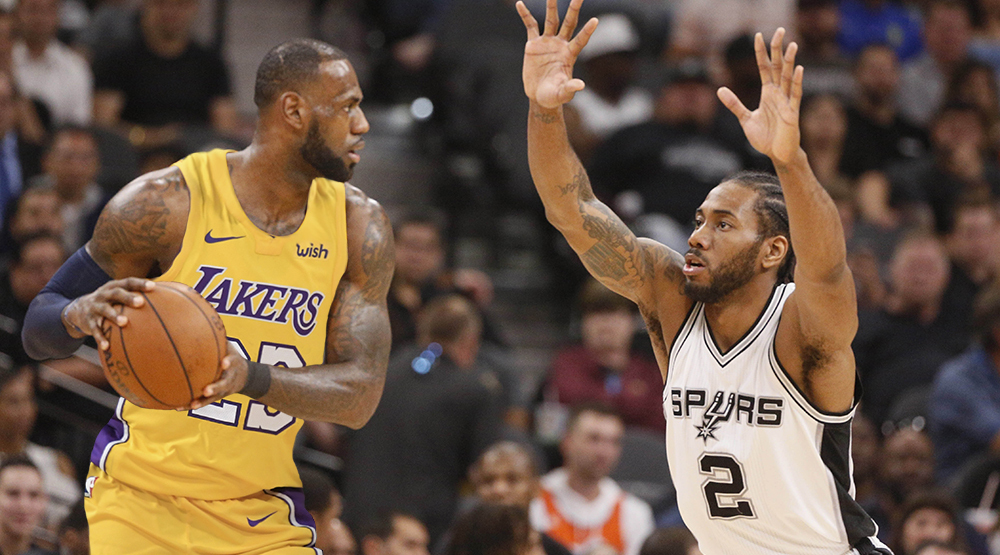
lebron-lakers-kawhi.jpgHe won an NBA title in 2012 and 2013, both with the Miami heat, before bringing a championship to his home city of Cleveland in 2016.

Over his 15-year NBA career, James has won four MVP awards, three Finals MVPs, has made 13 All-Star appearances, and won two Olympic gold medals.

Over the 2017-18 regular season, James averaged 27.5 points, 8.6 rebounds, and 9.1 assists per game, and played all 82 games for the first time in his career.

The New Rule That’s Going To Butt Heads

usp-nfl_-preseason-oakland-raiders-at-seattle-seah-e1533317481997Pro football fans on Sunday were greeted by a new N.F.L.
On the first full day of games in the 2018 season, there were surprises: Some of the most routine tackles, for example, are now penalties.

There were improvements: A reckless hit brought an immediate ejection.

And there was confusion: A new rule designed to curb the dangerous use of a player’s helmet was applied irregularly and did not prevent a scary injury.

It’s only one day. It will probably get better and you will likely get used to it.

You will also have no choice, because the N.F.L. is not turning back.

The new rules that went into effect in this season’s opening week are the first of perhaps many steps as the N.F.L. desperately tries to moderate the most hazardous collisions in an intentionally violent sport.

In five years, what might have raised eyebrows on Sunday will instead be viewed as customary. (It doesn’t mean these rulings won’t still fuel arguments.)

Sunday, fans got their first regular season look at the most talked about new rule in a decade, which makes it a 15-yard penalty for a player to initiate contact with an opponent by lowering his head. It is an effort to outlaw using the helmet as a weapon. Most notably, as the league repeated for weeks, the rule would apply to any player, including a running back or wide receiver, lowering his head to ward off a tackler or to gain a few extra yards.

download.jpegThe impact caused Johnson’s shoulders to slump and his legs went limp as he crumbled to the turf like a boxer absorbing a knockout blow. Johnson was later determined to have a concussion, his second in recent weeks. Three days before Sunday’s game, Johnson was medically cleared to play after a concussion in the preseason.
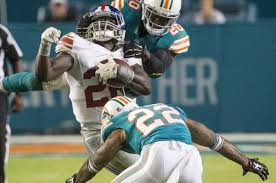
It seemed to be a textbook example of the kind of hit the new rule was meant to penalize — Johnson appeared to be positioning himself for a shoulder-first tackle until Patterson lowered his head and struck him with his helmet.

No penalty was called.

But throughout the league there were several penalties called on defensive players for helmet-to-helmet contact. Since the N.F.L. had rules in place before this season prohibiting hits to the head, each penalty may not have technically been a result of the new helmet use rule, but it surely appeared they were related.

Watching game after game Sunday, it seemed very clear that the officials had got the message from league headquarters that there was to be little tolerance for hits to the head, however they occurred.

In the first quarter of the Cincinnati-Indianapolis game, Colts quarterback Andrew Luck scrambled, and as he was tackled to the ground, the Bengals’ Shawn Williams drove his helmet into Luck’s helmet. Multiple penalty flags littered the field.

It was the kind of play that could have been a penalty before this season. It could even have led to an ejection, although that did not happen often.

This time, Williams was swiftly ordered off the field for the rest of the day. He will probably be disciplined additionally by the N.F.L.

So, if all the preseason talk about players not being allowed to lower their heads yielded a definitive statement like Williams’s ejection, then that is a good thing.

Which may have been the N.F.L.’s intent.

In a telephone interview last week, Dean Blandino, a Fox Sports rules analyst who until last year oversaw officiating for the N.F.L., said the new helmet rule was “all part of a culture change” within the league.

“I think the N.F.L. wanted to take a stance,” Blandino said.

download (1)There is another stance the league is taking. It wants to remind every N.F.L. player that quarterbacks are more important than all the other players on the field. And the N.F.L. is going to use penalty flags to continue to make that point.
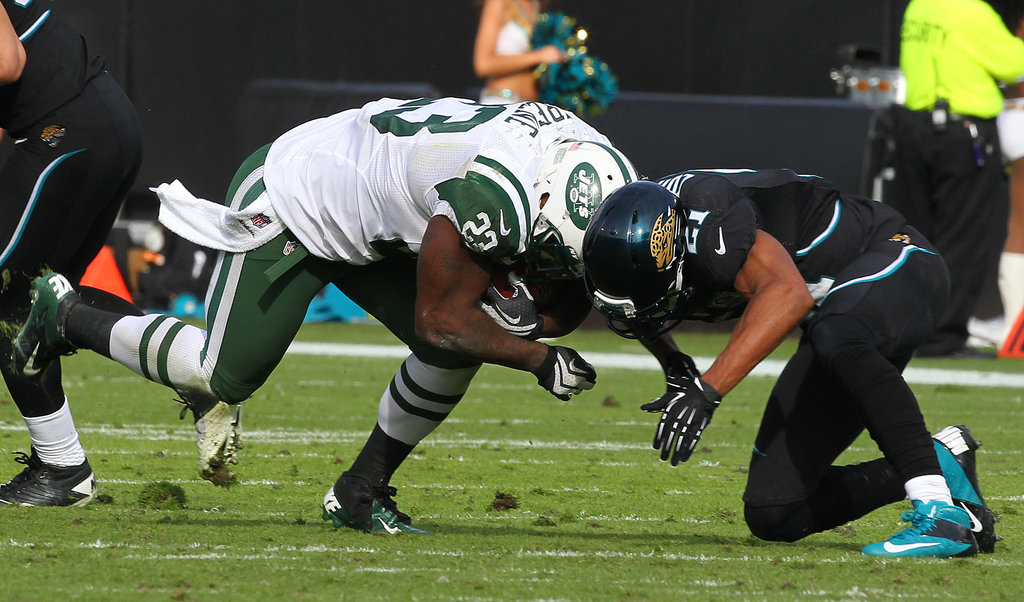
This season, one of the little-recognized changes in the rules was what the N.F.L. calls a “point of emphasis.” These are directives from the league to game officials about existing rules that it wants them to enforce more stringently.

Among the rules designed specifically to protect the quarterback, there is a clause about defenders not using all, or part, of their body weight to land on the quarterback if he’s tackled as he’s throwing the football or just after he has thrown a pass.

The exact wording of the point of emphasis was a reminder that “the defender is responsible for avoiding landing on the quarterback when taking him to the ground.”

It may be a good rule, especially considering that Green Bay quarterback Aaron Rodgers, who missed nine games with a broken collarbone last season, was injured again by a hit in the pocket Sunday night (Rodgers returned and led the Packers to victory over the Bears). But it’s asking a lot of defensive linemen. Most 300-pound men running at top speed and about to make a tackle are not as nimble as contortionists as they topple to the ground afterward.

But because of the new point of emphasis, Myles Garrett of the Cleveland Browns was penalized Sunday for falling on top of Pittsburgh’s Ben Roethlisberger as he tackled him. Same thing happened to Minnesota’s Sheldon Richardson because he couldn’t avoid a prone Jimmy Garoppolo a millisecond after shoving him to the ground. Cincinnati’s Carlos Dunlap received the same punishment after he sacked Luck, caused a fumble and did an athletic little flip forward to get off Luck as he hit the ground.

But Dunlap did sack Luck again two plays later by flinging him to the ground. No penalty, and the Bengals eventually won the game.

Yes, a new N.F.L., but change is hard

NFL-jumbo

Tom “Too Old” Brady

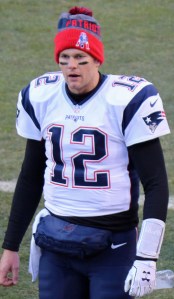
Tom_Brady_2016On paper, 2017 seems like a very typical Tom Brady season. He is leading the NFL in passing yards and sporting a 102.8 passer rating that’s his second-best since 2011. The Patriots are once again the No. 1 seed in the AFC, and Brady is the leading candidate to be named the NFL’s most valuable player.
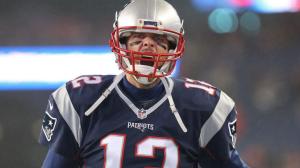
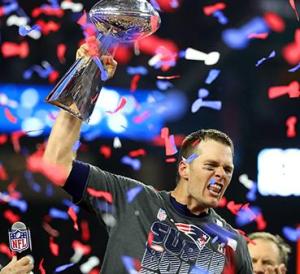
But over the past five weeks, there has been some trouble brewing in Foxboro — at least by New England’s own ridiculous standards. After the Patriots traded away Brady’s heir apparent, Jimmy Garoppolo, an ESPN report of an internal power struggle between Brady, coach Bill Belichick and owner Robert Kraft has clouded the future of the five-time champions. But perhaps more worrisome than this report is that Brady himself has been quietly marred in a slump.

Brady’s last five games of the 2017 regular season were uncharacteristically mediocre, despite New England going 4-1 in that span. Beginning in Week 13, Brady has posted a passer rating of 81.6, 17th best in the NFL,1 and his yards per attempt in that span were 6.95, 15th best in the league. He’s also been far worse in touchdowns to interceptions, going from 26-to-3 in his first 11 games to an unusual-for-him 6-to-5.

In the context of his career, Brady’s extended sample of poor play is surprising but not unprecedented. Dating back to 2007, when he turned 30, this is Brady’s sixth worst five-game stretch measured by expected points added2 based on the quality of his play. Brady accumulated 22.16 EPA in his last five games, for an average of 4.43 per game. His average in Games 1 through 11 was more than 2 points higher (6.76 EPA).

usatsi-9838950-tom-brady-yells-pregame-2016-afc-title-game

Yes, Brady was without his best weapon, Rob Gronkowski, for the worst game in the stretch, a 27-20 loss to the Dolphins in Miami, when he managed only a 59.5 rating and 4.16 EPA. But he capped the regular season at home against the New York Jets with his lowest yards per attempt of the year (5.14), with an active Gronkowski being held catch-less.

This could all be random variance. Maybe Brady is still eluding Father Time better than any quarterback in history and will soon erase all doubts, as he has before. He’s certainly fired up about even faint whispers of his decline. And the Patriots last year reportedly were planning as if his commitment to diet and training would allow him to play at an elite level for at least another couple of seasons. Brady, of course, seems to think he can continue pushing defenses around even when he’s pushing 50.

But if we were to look at the half-empty glass, we can draw comparisons to the career arc of Brady’s former long-time nemesis, Peyton Manning. No, not the Manning we last saw in 2015, who somehow won a Super Bowl with play so poor that his league-leading defense was forced to overcome it. Brady’s 2017 season is actually eerily similar to the 2014 Manning, who was his typical dominant self for the first 11 games of the year before falling off a cliff that can be seen now only in hindsight. At the time, the poor play was attributed to nagging injuries and not the inevitable end of one of the NFL’s greatest careers.

7-Tom-trophy_simin_bruty_1024x1024Neither quarterback gave any indication that anything was different if you look at the full-season statistics. But while we think a decline for a player happens neatly at the start of a season, Manning showed the circus can leave town at any time. For him, that time was his 12th game of the 2014 season. Previously, he was characteristically crushing the NFL with a third-best 109.5 passer rating and fourth-best 8.05 yards per attempt — that’s very similar to Brady’s first 11 games this year, with a 111.7 passer rating (first) and 8.27 yards per attempt (third).

But then Manning instantly transformed into an old quarterback: a 78.7 rating (24th) in his final five games with a TD-to-interception rate of 5-to-6, compared with 34-to-9 in the first 11 games.

Manning’s 2014 season ended with a home loss in the divisional round because of his poor play against an inexperienced playoff team with a third-year quarterback (Indianapolis’s Andrew Luck). Coincidently on Saturday, the Patriots will also take the field as a significant favourite at home against an inexperienced playoff team with a third-year quarterback (Tennessee’s Marcus Mariota).

Premature obits have been written for Brady before. There’s little reason to doubt New England based on what they’ve accomplished this century. But if Belichick and Brady are to get that unprecedented sixth ring, they will need Brady to look more like what he’s been and less like what he is: a 40-year-old quarterback.